Another Change of Scene

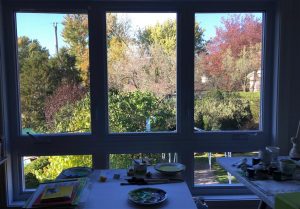
I had the opportunity to do a very short trip to Los Angeles during the Hollidays. Short in time, but far-reaching in joy as I was traveling with my eldest son Gabriel, just for the fun of being together. Coming from snowy Québec, it was quite an exhilarating change of scene.
The weather, of course, a soothing 68F after our minus 4 F at home. The wide open sense of space, the architecture, the vegetation and the people. On such a short trip, there is not time to settle into any routine, not even a travel routine: I was alert to my surroundings, taking it all in with curiosity and openness.

How would I be different if I lived here? How would that change my work? What would remain the same? Those are questions that come up when I travel. It’s fascinating to imagine and from my experiences of living abroad, I know another part of me would emerge, enriching my life and those around me.

Going further in this reflection, I also wonder what would remain at the core. Beneath all the variants, what is truly my fundamental self and what is the essence of my work? This question is even more interesting to me, and not so easy to answer.

Because in whichever life I would choose, I would end up asking myself: What is the truest work I can do, here and now, with what I have?

And that is a whole new world, right there, waiting fo me.

Louise Jalbert, Self-portrait in Los Angeles, Photography

Change of scene

Winter has arrived here in Québec, settled in comfortably with a few inches of snow to set the scene.

All is white now. The snow reflects light which further pales everything.

I always dread losing the deep colors of fall. As I do moving away from the sumptuousness of summer. The range of colors that surrounds at the present time is restrained and sober: whites, grays, browns and some blues.

On some evenings, there are pinks and violets.

And sometimes, after a fresh snow, sparkles of cristal shine in the sunlight. This is magical.

It takes me back in time, some Christmases ago. I was given a set of paint, in small plastic jars with a small brush, and to my amazement, one was gold and the other was silver, both with sparkles.That was very new, then.

The gift now is the exercise in restraint and nuance these months of austerity bring to my my eyes. I get to see better, with more subtlety.

And the wonder lives on, when I look, and when I paint.

May your Hollidays be Joyous and Sparkling!
May 2018 bring you Peace, Health and Joy!

Louise Jalbert, Bushes and Blue Snow, 2017, Watercolor and gouache on paper, 4 x 7 inches

Observe, said Yogi

“You Can Observe a Lot Just by Watching”

That quote from Yogi Berra sounds obvious, even simple. And it is.
That makes it easy to do.

https://baseballhall.org/hof/berra-yogi

This is what I do, watch and paint, paint and observe.

It’s easy to get caught in detail when you paint from observation. But what I want to paint is not literal, it is not a photographic image. It lies beyond what I see and within what I do.
So, I observe and I paint, and then I look at what I have painted. Observe that and keep painting and observing.

I get to see a bit more with each sketch.

In the meantime, with the Hollidays coming up, I thought you might enjoy reading or giving this book: “Still Life” by Louise Penny
https://www.amazon.com/Still-Life-Louise-Penny/dp/0312541538

While honing your skills in observations of another kind, it is gripping and amusing. I never read crime novels but Lori Sailata’s suggestion was worth listening to. I hope you enjoy.

https://medium.com/@sailiata

Louise Jalbert, Afternoon in November, Sketch # 6, 2017, 11 x 16 inches

More Studies

I’ve been working on variations of this image for two weeks now.
I am trying to clarify the vision I have, a glimpse of eternity that caught my eye, one late afternoon in November.
I want to paint something elusive that lies beyond what I see.

In my effort to catch it, I keep focused on the trees, the bushes, the light. Determined, I juggle with colors, composition, scale and brushstrokes.

Still, it eludes me.

I may be trying too hard. But I know there is a process happening here: once I have done several studies, enough to know this particular theme by heart, then I will be able forget about the represented elements in the picture. And when my hand will start to have a mind if it’s own, then I will reach a balance of attention and abandon that makes it all breathe.

Or shall I say dance?

I like to dance, and I can see the similarities here. First, there is a warm up. Then there are steps to be learned, and practiced until your body knows how to move with the music. That’s when expression jumps in.


One early sketch:
Much looser than the colored gouache above, it is closer to what I am aiming for.
Drawing in black and white in a small scale allows me to focus on the essential.


In the studio, I am stepping on my own feet right now.
But I hope to be dancing soon.

Louise Jalbert, “Afternoon in November, Study #5”, 2017, 12.5×15 inches  and  “Afternoon in November”, sketch, felt marker on paper, 3 x 3 1/2 inches                            

Tailor Made

Last Sunday, I went to visit a young friend’s exhibition, held at the Maison de la culture Villebon in nearby Beloeil. Nathalie Vanderveken and I met while being involved in an emerging artists’ association, Agrégat, a few years ago.

At the time, she was a student in visual arts. She has since completed her studies brilliantly, developing an interest in the representation of garments and, through apprenticeships in printmaking, a love of paper.

The exhibit is called “Tailor-made” because the artist takes her inspiration from the dress patterns that are used to make clothes.
But that’s only the beginning…

First, she unfolds the patterns and looks at them. The fine paper printed with marks, layouts of dotted lines, arrows and instructions, are intended as a blueprint to make a piece of clothing. What Nathalie sees in them is a world of visual possibilities.

The artist uses them as a starting ground to make clothes-like sculptures, deconstructing the volumes and reassembling them in forms that have little to do with their anticipated use. We are reminded of garments and of the bodies they are meant to dress. Using a mixture of materials, mostly paper that is sometimes solidified with a Japanese paste called Konnyaku, she brings a contrast of structure and movement, of rigor and some degree of softness that makes the art evocative and yet unsettling.

This tailor-made body of work is far from responding to the constraints of a design. Rather, the artist explores with it the freedom to work without compass.
What I find stimulating here is the dynamic offer to our perception. These drawings and sculptures by Nathalie Vanderveken are challenging our minds to a fragmentation and redefinition of the way we look at form.

I find that quite inventive and liberating.

Nathalie Vanderveken, “Tricolor”, Polyurethane foam, artificial leather, Kraft paper, corrugated cardboard, felt marker, pencil and woodstick.

The landscape of our minds

“Any landscape is a condition of the spirit”

This beautiful quote is from the Journal of Henri Frédéric Amiel. Short, powerful and somewhat enigmatic, it takes our imagination on a flight.

Even though I would not venture to explain it philosophically, this statement makes a lot of sense to me. Maybe because I’ve been looking at nature for a long time, and observing it carefully while painting, I have come to form my own intuitive relationship to this idea.

Whether in reality, in visual representation or in our imagination, the idea of the landscape lends itself to a projection of our spirit. Such a setting enables our unremitting thought process to pause and allow our minds to settle on an intricate leave pattern or the silent march of clouds in the sky. It is a world alive with multiple forms, textures, colors and spaces, offering an array of sensations. As it continually transforms itself, so can we acknowledge our own changes. Yet, under its ephemeral nature lies a sense of permanency that we can appreciate.

Thus, the outer landscape lends itself to the reflection of our inner landscape, much like a screen filled, not with thoughts and words, but with visual and sensory perceptions that speak directly to our souls.

Louise Jalbert, Foliage on Sky, 2017, Watercolor on paper, 3 x 5 on 7 x 11 inches

Striving

There is so much I want to say about nature, what it means to us, and why I want to paint it. As I am working my way to a new form in my art, all these questions are dangling in my head.
This week, the effort is to clarify what I see and how I want to express it. It was clear last week, it is not anymore. There is too much going on in my mind, too many things I want to do at once.
This sketch shows where I am: it is crowded and overworked. It had to be, because that is how I figure out what I want. Ideas have to materialize into paint and paper before I decide what to keep or not.

I am aiming for simplicity and clarity. But I am painting profusion, trial and error as well as some emerging color ideas.

I love the intensity of gouache. After the freshness and limpidity of watercolor, which I also loved, it feels as sensuous as chocolate. And while I am discovering what I can do with it, this simple pleasure fuels my quest.

Louise Jalbert, “October Colors on the Lake, Saint-Bruno”, 2017, Gouache on paper,  11 x 15 inches

Mystery

I am attracted to art that leaves room for the imagination. That is compelling and evocative. Art that makes you feel before you think.
One of my early passionate readings was the Journal of Anaïs Nin. (https://en.wikipedia.org/wiki/Anaïs_Nin)
A sensitive, imaginative and audacious writer, Nin has acquainted me with the importance of poetry and the power of suggestion.

Poetry is a mystery, and if you want to draw close to human beings you cannot speak in parables. I pondered on mystery and suggestion, on all that Djuna Barnes did not tell us, all that Proust did not tell us, and in what Henry James did not tell us. In poetry and the myth, you avoid explicitness, but only to reveal another aspect, another life.

Anaïs Nin,
The Journals of Anaîs Nin, 1947-1955

I love the idea of being suggestive, of not being too explicit, and inviting the viewer to a realm beyond what is painted.
When I do a first study, I tend to to put a lot of details in, because I want to capture everything I see. It can take several essays to extract what has caught my attention.
The sketch above is a study of my neighbours’ tree, as seen through the branches of a another tree in front of my window. This combination of form and color happens only at this time of the year. It is ephemeral, beautiful and begs not to look like a postcard. This is my challenge: to capture this beauty and make it visible, even tangible, while keeping alive it’s mystery.

Louise Jalbert, “Yellow Foliage and Dark Branches”, 2017, Gouache on paper, 8 x 10 inches


Beauty

On Monday a fierce autumn wind was shaking trees and tearing leaves ruthlessly away from their branches. The splendor of October is now being swept away to be followed by the stark beauty of November. The last few weeks have provided a visual feast, treating us with the sparkling light and extravagant colors of the Québec fall. This ultimate abundance seems to me as nature’s way to saturate our souls and senses so that we may better welcome the austerity of winter.

It is an interesting lesson in thinking about beauty and its many opposite forms. What is beauty, we may ask? How does one define it? There are probably as many meanings for beauty as there are individuals. But I believe that, deep inside us, we all have a yearning for it.

Irish poet and philosopher John O’Donohue brings a sensitive and profound definition of beauty in the following interview with Krista Tippet:

Beauty isn’t all about just nice, loveliness like. Beauty is about more rounded substantial becoming. So I think beauty in that sense is about an emerging fullness, a greater sense of grace and elegance, a deeper sense of depth, and also a kind of homecoming for the enriched memory of your unfolding life.

John O’Donohue

John O’Donohue — The Inner Landscape of Beauty

I admire how O’Donohue articulates such elusive thoughts and stimulates a resonance in our minds with his words. Such is the power of poetry. There is a stirring going on inside me and I feel as if I understand beauty in all its magnificence.

Being neither a philosopher nor a poet, I find defining beauty a bit daunting. In fact, it is quite difficult. But I am drawn to it in all its forms and I like to explore this notion with my own tools, which are color and paint. I may stumble, but what keeps me going is the hope of somehow communicating my own wonderment of this mystery.

Louise Jalbert, “October Foliage”, 2016, Watercolor on paper, 15 x 22 inches

Stepping Stones

Last week, I wrote about changing from one technique to another, from watercolor to gouache. That change had been brewing in me for a while and though technique will play an important part, it’s about more than technique. It’s about expanding my art, working out some ideas, and developing new skills. Changing technique is good way to start this process.

But before I get very absorbed with this new body of work, I have some unfinished business to attend to.

Prior to my departure for France, I had started a few watercolors, that were left aside. For some of them, it was a lack of time, for others, I was stuck. Both the trip and stepping into a different technique have given me the distance to get back to them with a fresh eye. Thus before I really move ahead with another project, I want to complete them.

It’s not that everything I wanted to do with this project is done. That’s impossible, and unattainable. Still, I am happy with what I did and learned, for now. It has generated a lot of ideas I want to take into another form of painting
(http://www.tate.org.uk/art/art-terms/f/form).

That form is still to be found, and here’s why getting back to unfinished work will be a good thing.

It gets me back in touch with the numerous ideas that were were brimming in my mind while I was painting.


Ideas on composition such as:

How far can I render a tapestry-like effect in nature before it gets too even?

Ideas on color such as:

How many greens are there and how do you make them alive?


You can see several attempts here.
Did I exhaust those ideas? I feel I barely started to explore them. And as I forge ahead, they will be my stepping stones to the next form.

 
Louise Jalbert, “Branches and Foliage”, 2017, Watercolor on paper, 11 x 15 inches, and other unfinished watercolors in the studio.