A Pilgrimage in India

I just came back from a pilgrimage in India, something I had wanted to do for a long time, and recently had a chance to realize.
India has a rich and deeply rooted tradition of spirituality; countless saints and enlightened beings have lived there, disseminating their wisdom for centuries.
I wanted to walk in their footsteps, bathe in the air they breathed and watch the sun rise over the same hills.
This is the land where the ancient knowledge of yoga originated and developed. Through the gateway of it’s perennial teachings, I hoped to walk a little closer to my own truth.

Lucky me, I shared this experience with a group of wonderful people, several of them advanced yoga practionners and teachers. In that regard, I was the junior of the group, and benefited from their knowledge.

The purpose of a pilgrimage (yatra in Sanskrit) is to exercise mental and physical flexibility by doing tapasyas (asceticism) and being confronted to the unexpected and unknown.


Our guide and organizer for the trip was Atmaram (in red shirt above), himself an experienced and much appreciated teacher.
https://www.facebook.com/AtmabalaYoga/

His guidance was in the best sense of the word, attentive while challenging us gently, taking our practice from the yoga mat to everyday life. Atmaram also introduced us to places and people he had come to know while on pilgrimages with his master, Swami Vishnudevananda, himself a disciple of Swami Sivananda.
http://www.sivananda.org/montreal/en


The road can be long and harduous but it leads you to higher landscapes and clearer skies. In our case, it went from Delhi to the Himalayas, close to the source of the Gange near Gangotri.


We gathered more than holy water; we developed strength and clarity in our bodies and minds. Friendships blossomed. Our practice deepened as laughter sparkled through the teachings we received.


Aren’t we all pilgrims on this earth? Our lives can be a journey of self discovery and realization. The steps we took during this pilgrimage will inspire us yatris as we go forward.
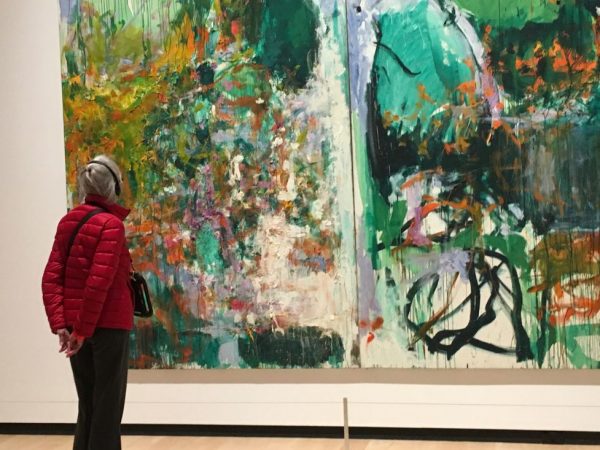


Main photo: Rishikesh, Uttarakhand:  The pilgrimage city sits at the foothills of the Himalayas from which flows the river Ganges.
Photo #2: Our group with Swami Hariomananda, whose teaching was good humored. Photo by Plamena Stoyanova
All other photos Louise Jalbert, “Pilgrimage in India 2018”

Looking at a Joan Mitchell Painting

Following last week’s photo essay on people in museums, this week features Joan Mitchell’s paintings.

Joan Mitchell’s paintings exude a raw energy, intense, even furious at times that cohabits with a lyricism and subtlety that is not always visible at first glance. Beyond the mere interpretation of a landscape, we can see a vivid expression of the inside turmoil that often agitates us all, pouring forth in daring brushstrokes, both desperate and tender.

The dynamism of the above painting is striking, and as one friend reflected, in this instance, makes the viewer seem static.

http://joanmitchellfoundation.org/work


In the above detail, we can see the forces at play in Mitchell’s work: gesture and paint matter used in a broad array of possibilities, impulsion and restraint, dark colors along with translucent ones, suggesting depth and evanescence together.


Mitchell uses the white canvas to offset her colors, either as seen through a transparent layer, or in between deeper tones.


It seems fit to conclude this short tribute with one major work that brings together these two major painters.

In November 1992, upon learning of Joan Mitchell’s death, Jean-Paul Riopelle was compelled to paint the “Hommage à Rosa Luxembourg”, a vast tryptic of 30 paintings, his tribute to Joan Mitchell.

https://www.mnbaq.org/en/exhibition/jean-paul-riopelle-1213


This last major work is by Riopelle is located in the corridor that links the old part of the museum with the new pavillon Pierre Lalonde, where the exhibition took place.

This week’s photos are taken in front of Joan Mitchell’s paintings, part of an exhibition that took place last fall at the Musée national des Beaux-Arts du Québec.
This was the first ever exhibition to focus on the 25 years relationship between painters Jean-Paul Riopelle and Joan Mitchell, and how that relationship influenced their respective art.
Main photo: Woman in front of :Joan Mitchell, A Garden for Audrey, Oil on canvas, Dyptich, 1974, Estate of Joan Mitchell
Photo 2: Joan Mitchell, Untitled (detail), Oil on canvas, 1961, The Joan Mitchell Foundation, New York
Photo 3: Visitors looking at Jean-Paul Riopelle, “Hommage à Rosa Luxembourg” 1992. Acrylic and spray paint on canvas, 155 x 1 424 cm (1st element); 155 x 1 247 cm (2nd element); 155 x 1 368 cm (3rd element), Coll. MNBAQ. Gift of the artist.
All photos: Louise Jalbert

Muses in Museums, Mitchell/Riopelle Exhibition, Part One

Muses in Museums is a series of photographs about the relationship of people with art in museum spaces. In this first part, the paintings are those of Jean-Paul Riopelle.
https://en.wikipedia.org/wiki/Jean-Paul_Riopelle


There is a moment of stillness that I find moving while people are are observing and reflecting in front of a work of art. They are absorbed in contemplation and time seems to stop.

But time doesn’t stop and I have to act very quickly before the person moves on. I find it very playful to catch a visual composition that happens for a few seconds only.

Sometimes a color combination can convey the relationship between the people and the artwork they are looking at.


It can also be a contrast: here the flat, dark shapes of the heads and coats frame and accentuate the rythm and texture of the painting.


And sometimes, the figure just seems to become a live part of the art.


This week’s photos were taken during an exhibition that took place in the fall of 2017, at the Musée national des Beaux-Arts du Québec.  
This was the first ever exhibition to focus on the 25 years relationship between painters Jean-Paul Riopelle and Joan Mitchell, and how that relationship influenced their respective art.
https://www.mnbaq.org/en/exhibition/mitchell-riopelle-1252
https://www.gallery.ca/collection/artist/jean-paul-riopelle

The Wind

If you were a force of nature, which one would you be?

A wise friend came up with this question recently. A great question that keeps resonating within me, firing my imagination.

Today, I would be the wind.

Wind brings motion and change. It carries the birds, disseminates pollen and seeds, fertilizing the earth. It chases the clouds away to let the sun in. And it brings them back so we can have rain.

There is motion and change in the studio also, as I am circulating between ideas and techniques, past and present work.

The above painting was started a few years ago. I got back to it this week with a fresh eye. Something needs to be improved, but it’s breathing again now.

How about you? If you were a force of nature, which one would you be?

Louise Jalbert, “Foliage in Appletree”, work in progress, 2013-2018, Oil on canvas, 30 x 30 inches

Rhythm and Color

Rhythm, pattern, movement, color and space are all components of my work in painting. This week, I have focused exclusively on rhythm and color.

Focusing on theses two variables allows me to define how I want to use them.
Playing with them in different sizes, techniques and gestures helps me see which are closest to my vision.

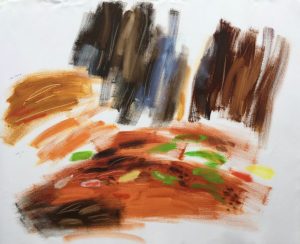
Since I want to take my work further, in a bigger size and bolder manner, I did some tests on loose canvas.
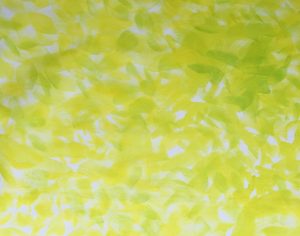
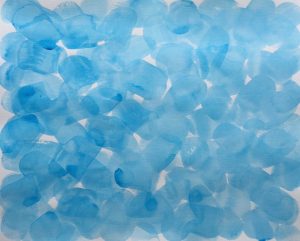
I used one or two colors, big brushes, with spontaneous and broad gestures: the results are surprisingly fresh and lively, each with their own own pattern.

There is a valuable lesson in simplicity here. But I want to add contrast and bit more complexity.

Where do I go from here? The next step will be in that direction, bringing more colors and rhythms together.

Where will it lead? I have an idea, but being open to what comes is part of the adventure.

 Louise Jalbert, Various painting tests, 2018,
Rhythm of blues, oil and acrylic on canvas, 34 x 37 inches
Verticals and horizontal movements, oil on canvas, 25 x 30 inches
Yellow Foliage, acrylic on canvas, 22 x 28 inches
Blue April Sky, acrylic on canvas paper, 16 x 20 inches

Don’t mind the mess, I am just starting.

I’ve put the winter gouaches aside and I’d like to do some bigger, bolder work now. So here’s a start: the above oil sketch is somewhat disheveled and chaotic. I am searching and trying out new ideas and not all of them will be good.

My aim is to expand my expression with new means. In order to find those new means, I am experimenting with different formats and techniques: interesting things happen when I play with these variables.

Is it merely a question of format or technique? Surely not, but stepping into another painting territory always yields new insights, challenging my habits. It takes me on a path of exploration and discovery.

 Oil Paint:
There’s no other medium as luscious and sensual as oil paint. I work on a glass palette: it’s great for mixing colors and easy to clean. Oil is messy, but the smell of it is like perfume to me, though a potent one!

How can I catch the smell of trees, the intricacy of bare branches, the wind whispering through them? How can I bring you, the viewer, into a space, a world of colors and brushstrokes that will make you stop and feel it all?

Those are the questions that drive me. Stay tuned.

Louise Jalbert, “Branches”, study, 2018, Oil on canvas, 26 x 31 inches

In Between

End of March is a time in-between, or so it seems here in Québec. Winter is receding by a few inches of melted snow each day, and spring is in the air, but not quite obvious yet.

It seems as if nature was holding it’s breath, before the grand renewal.

But light is already playing out: it is raw, intense and free to dazzle everything it touches. Trees do not have leaves yet to filter it’s glare, and the last patches of snow reflect it brilliantly.

Everything else seems to be is in waiting, or in preparation, just about to explode in an unabashed rush of vitality in plants, animals and us too.

It is a moment in between, undefined, and poised before the great leap.


Louise Jalbert, “Before Spring”, 2018, Gouache on paper, 8 x 10 inches